Average handle time (AHT) measures how long a customer interaction takes from start to finish. It is one of the most-watched contact centre metrics, and one of the easiest to misread in a hotel — because a hotel phone receives calls that have almost nothing in common with each other.
What is average handle time, and how is it calculated?
The formula is simple: add talk time, hold time and after-call work, then divide by the number of calls.
AHT = (talk + hold + after-call work) ÷ total calls
Counting all three is not a stylistic choice but the definition itself: in COPC’s customer experience standard, AHT is an efficiency metric that includes the work attached to a contact alongside talk and hold time, and it is used for capacity planning on that basis.
In hotels the third component is the one most often left out. Entering the booking into the system, leaving a note for a colleague, sending a quote on WhatsApp — that is all part of what the call cost. A property that measures only talk time can be missing a third of its real load.
Benchmarks by industry: where does hospitality sit?
The industry ranges published by Zendesk show what counts as a normal call length:
| Industry | Average handle time |
|---|---|
| Retail | 3–4 min |
| Banking and finance | 4–6 min |
| Telecommunications | 5–7 min |
| Technical support | 8–10 min |
| Healthcare | 6–8 min |
| Travel and hospitality | 3–5 min |
| Utilities | 4–6 min |
| Insurance | 5–7 min |
Source: Zendesk, Average handle time. The same source describes roughly six minutes as a healthy general balance point.
Hospitality sitting near the bottom at 3–5 minutes is no surprise: that range mostly reflects support calls. In a hotel the same number receives both “do you have a room tomorrow” and “what would a family room cost for five nights”, and those are not the same job.
Realistic durations by call type
Splitting the number by call type makes both the target and the staffing plan meaningful. The breakdown that keeps recurring in practice:
- Booking conversation (4–7 min): dates, party size, room type, board, rate, cancellation terms. A shorter call here is usually not good news — selling takes time.
- Availability or rate question (1–2 min): the guest wants one fact. If it runs long, the fact was not at hand.
- Cancellation or date change (3–5 min): find the reservation, explain the terms, process the change. After-call work is heaviest here.
- In-room request (30–60 sec): towels, late checkout, something broken. If routing the request to the right department takes longer than the call, the problem is the workflow, not the metric.
- Directions and general information (under 1 min): repetitive, and high enough in volume to drag the overall average down more than anything else.
Once you have that breakdown, “our average is three minutes” stops meaning anything. What matters is that booking calls run long enough and information calls run short enough.
Where AHT misleads a hotel
Here is the detail that matters: a call that is never answered never enters the calculation. When the front desk is busy and the phone rings out, that call does not hurt the average — it lowers it. AHT is a metric that improves as calls are missed.
This is well established in the research literature: what call centre models long left out is the customer who stops waiting and hangs up. Garnett, Mandelbaum and Reiman (2002) show that planning models which ignore impatient customers systematically misjudge the capacity a centre needs. For a hotel phone, the practical translation is that an abandoned call shows up in lost bookings, never in the average.
So it should never be read alone, but alongside your answered-call rate and conversion per call. What a call falls back to, and in what order, is covered in the fallback order guide.
The second trap is treating a low average as a quality signal. Zendesk flags this too: a very low AHT can mean conversations are being rushed or closed before the guest was fully answered. The measurement literature is blunter still — when Feinberg and colleagues (2000) tested call centre metrics against caller satisfaction, the two that showed a significant relationship were the share of calls resolved on first contact and the abandonment rate; average talk time was not among them. In a hotel, the price of that is a booking that never closes.
What you need in order to measure it
To calculate AHT you need each call’s duration, its hold portion, and a record of what was done afterwards. Without that, the metric becomes an estimate.
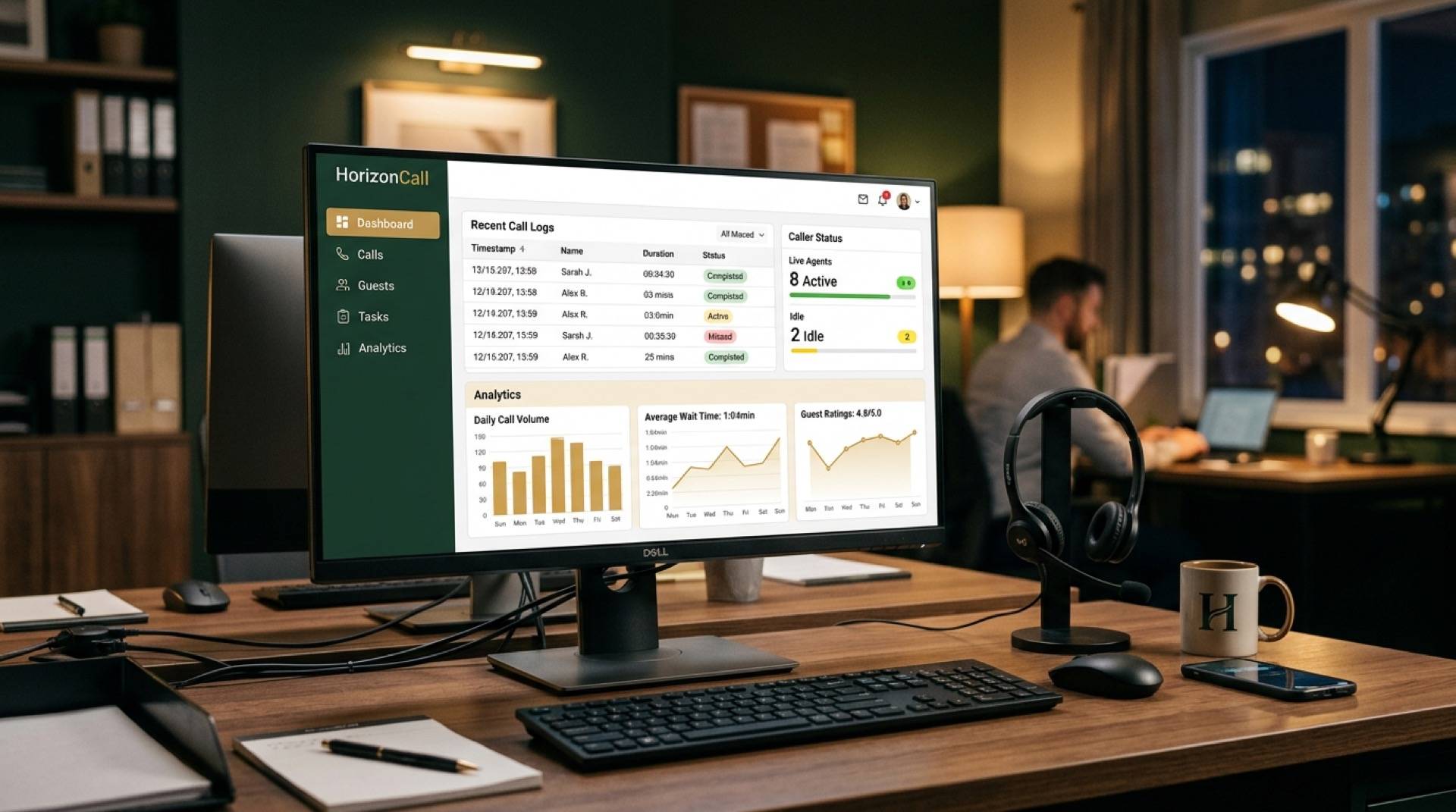
HorizonCall records the duration, a summary and the channel of every conversation, and because phone, WhatsApp and Instagram merge into one history, a single guest’s total contact time is not scattered across channels. What that changes at the front desk is covered in the one-inbox guide.
How an AI assistant changes the number
The assistant does not affect the three components equally. Hold time effectively goes to zero, because the guest never waits while someone looks something up. After-call work largely disappears too: the summary and the request are captured as the conversation happens.
The conversation itself does not have to get shorter. Closing a family-room sale in two minutes instead of three is not an achievement. The real difference is not in the average but in capacity: because the assistant answers several calls at once, fewer calls queue at peak hour — and calls that were never measurable before become data for the first time.
The standard reviews of call centre operations point the same way: waiting, abandonment and service time are quantities to be managed separately, and no single average speaks for any of them (Gans, Koole & Mandelbaum, 2003; Akşin, Armony & Mehrotra, 2007). Read for a hotel, the sentence is this: the goal is not a shorter conversation but a higher share of guests answered without waiting at all.